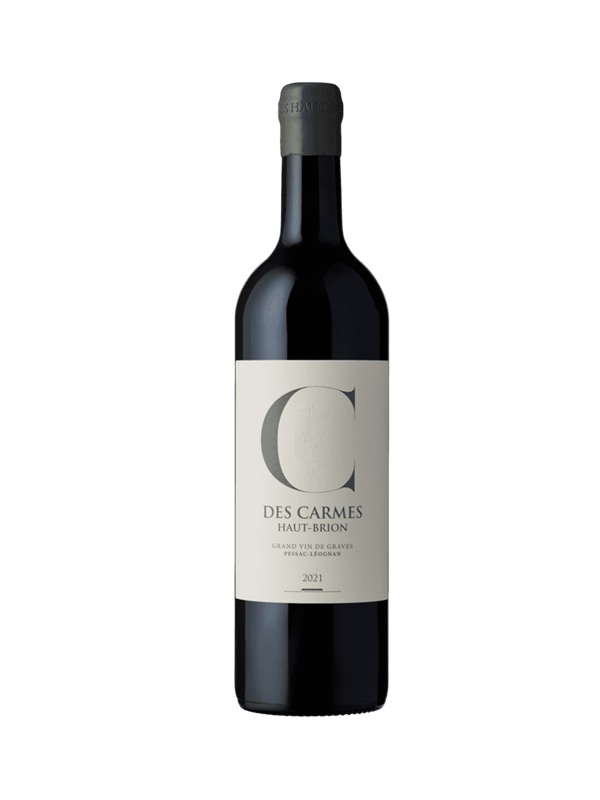
Le C des Carmes Haut-Brion
Ripened in the soils of Martillac, C des Carmes Haut-Brion is a beautiful prelude to pleasure.
Using a more traditional blend, C des Carmes Haut-Brion focuses on Merlot subtly complemented by Cabernet Sauvignon. The fruit is in the spotlight here, offering an elegant range of aromas. Drunk young, the wine develops a crisp intensity which will gain the patina of beautiful complexity as the years pass.
Blend:
62 % Cabernet Sauvignon, 36 % Merlot, 2% Petit Verdot
Vats used :
Tronconic stainless steel tanks (60 hL), Concrete tanks (50 hL), Wooden tanks (76 hL)
Barrel maturing: 72 % foudres of 30 hL, 20 % new barrels, 8 % amphorae
Duration: 24 months in barrels, then concrete tanks
Noteworthy features of the vinification and / or maturing :
No crushing, 20 % of whole bunches
The beginning of a legacy
In 1584, Jean de Pontac, the lord of Haut-Brion, donated several acres of meadows and vines to the Carmelite Order. This show of favour doubtless had a hint of predestination about it: the members of the congregation took their name from Mount Carmel, which literally means ‘God’s vineyard’. They cared for the land for nearly two centuries, showing the same devotion in both their penance and their wine production.
Well-kept secrets
After being confiscated during the French Revolution, the estate was purchased by the Léon Colin family in 1840. Their descendants the Chantecailles put years of work into enhancing the property, adding a chateau and landscaped grounds, before selling it to Patrice Pichet in 2010. From one family to the next, these limited changes of ownership have helped to preserve the spirit and magic of the site.
Characterful land
The ten hectares of land are made up of gravel, clay and sand. In this unique geological palette, affinity with the land guides the blend of grape varieties planted (itself also unique): Cabernet Franc (39%) and Cabernet Sauvignon (20%) gaze at each other from either side of the stream, with Merlot (41%) growing a little farther away. This mosaic of plants is what gives the estate its unusual profile.
The winery
The new winery, designed by Philippe Starck and Luc Arsène-Henry, which opened in 2016, marked the start of a new era for the chateau. Combining art with state-of-the-art equipment, it embodies a new pursuit of excellence.
Design and function
The central harvest reception area opens up onto the vat room where 1,200 hectolitres of wine are fermented in oak, stainless steel or concrete. Below, where water encircles the structure, some 300 barrels sit patiently in ideal maturation conditions. Finally, the top floor is crowned with a tasting room offering a vineyard panorama, where the year’s work can be savoured.